
Foreign Residents in Portugal: Top 20 Nationalities (as of 2025 Data)
Portugal’s foreign resident population reached an all-time high of over 1 million in recent years. According to official figures from AIMA (Agência para a Integração, Migrações e Asilo, which replaced SEF) for the end of 2023, there were 1,044,606 legal foreign residents in Portugal (AIMA publica Relatório de Migrações e Asilo 2023).
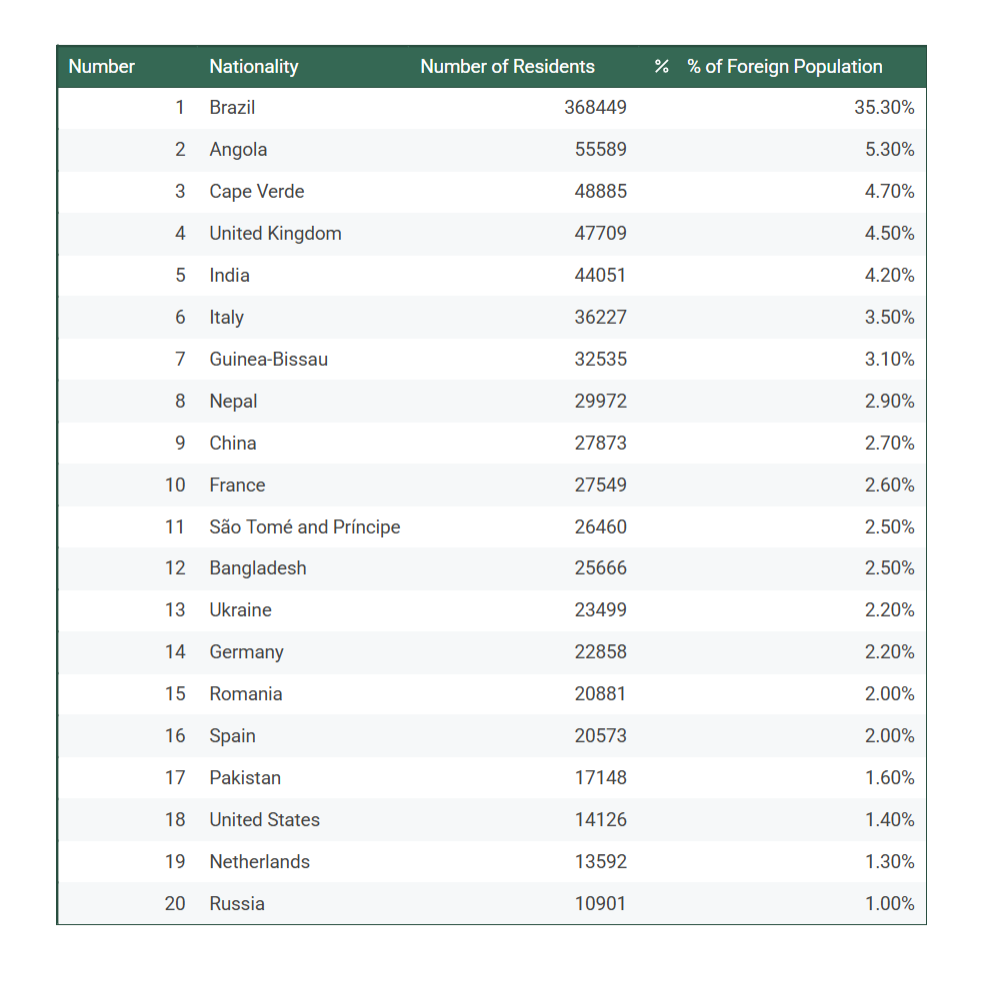
This represents a 33.6% increase from 2022, continuing an eighth consecutive year of growth (AIMA publica Relatório de Migrações e Asilo 2023). (Preliminary data for end of 2024 indicate the number rose further to about 1.55–1.60 million after accounting for pending regularizations (Imigração: mais de 1,5 milhões de estrangeiros residem em Portugal — idealista/news).) The table below details the top 20 foreign nationalities by number of residents, along with their share of the total foreign population:
Foreign Nationalities
Source: AIMA “Relatório de Migrações e Asilo 2023” data (legal resident foreigners by nationality) (AIMA rejects idea of “huge wave of migration” – The Portugal News) (AIMA rejects idea of “huge wave of migration” – The Portugal News).
Brazilians are by far the largest foreign community
As shown, Brazilians are by far the largest foreign community in Portugal – about 368.4 thousand people, comprising roughly 35% of all foreign residents (AIMA rejects idea of “huge wave of migration” – The Portugal News). The next-largest groups are Angolans (~55.6k, 5.3%) and Cape Verdeans (~48.9k, 4.7%) (AIMA rejects idea of “huge wave of migration” – The Portugal News). The British constitute around 47–48k (around 4.5%) (AIMA rejects idea of “huge wave of migration” – The Portugal News), followed closely by nationals of India, Italy, Guinea-Bissau, and Nepal (each between ~30–44k).
Significant foreign resident communities also include Chinese, French, São Toméan, Bangladeshi, Ukrainian, German, Romanian, and Spanish nationals, each contributing about 2–3% of the foreign population. Rounding out the top 20 are Pakistan, the United States, the Netherlands, and Russia, with smaller (but still notable) shares. Together, these top 20 nationalities account for approximately 87.5% of all foreign residents in Portugal, with the remaining ~12.5% coming from numerous other countries.
Overall, Portugal’s foreign-born population now represents roughly 10–15% of the country’s total population (Portugal’s Foreign Population Hits 15%: An Industry Perspective from the Investment Migration – The Portugal News). This is a dramatic rise from just ~3-4% a decade ago. The growth has been fueled by immigration from Lusophone African countries (thanks in part to new CPLP residence permits), Brazil, as well as an influx of Europeans (e.g. from the UK, Italy, France) and Asians (such as Nepal, India, Bangladesh) seeking opportunities in Portugal (Foreign residents in Portugal reached a record number in 2024) (AIMA rejects idea of “huge wave of migration” – The Portugal News).
Despite the rapid increase – nearly quadrupling from about 422k foreigners in 2017 to over 1.5 million in 2024 (Imigração: mais de 1,5 milhões de estrangeiros residem em Portugal — idealista/news) – officials note that Portugal remains 18th in the EU in relative terms (its foreign-born percentage is still moderate) (Foreign residents in Portugal reached a record number in 2024). The Portuguese government is actively managing this growth with pro-immigrant policies and streamlining of immigration processes, given that migrants have contributed positively to the economy (e.g. contributing far more in taxes than they receive in benefits) (Foreign residents in Portugal reached a record number in 2024). The data above, drawn from official sources (AIMA/SEF, INE), provides the most up-to-date portrait of the foreign resident population by nationality as of early 2025, underscoring the diversity and changing profile of Portugal’s immigrant community.
The Rise of American Residents — Growing Fast, Still a Tiny Community
While news headlines often spotlight the “surge” of Americans moving to Portugal, it’s important to keep this trend in perspective. Yes, the U.S. population in Portugal has grown significantly in recent years—more than doubling since 2019 and reaching around 14,100 legal residents, according to AIMA’s latest reports.
But despite the rapid growth rate, Americans still represent just 1.4% of Portugal’s total foreign population, making them a relatively small community compared with long-established groups like Brazilians, Angolans, Cape Verdeans, or even the British. In practical terms, this means that while Americans are increasingly visible in places like Lisbon, Cascais, and the Algarve, they are far from dominating the demographic landscape. The American presence is rising, certainly—but in the broader context of over 1.5 million foreign residents, it remains modest.
Why More Americans Are Choosing Portugal
The growing interest from Americans isn’t happening by accident. Portugal offers a rare blend of safety, affordability, stable healthcare, Mediterranean climate, and a slower, more community-driven lifestyle—qualities that resonate strongly with families, retirees, and remote workers alike. Visa pathways such as the D7, Digital Nomad Visa, and (to a lesser extent now) the Golden Visa have made long-term residency accessible, while English proficiency is high in most urban and coastal areas, easing the transition for newcomers.
Add to that Portugal’s reputation as one of the safest countries in the world, and a booming digital and entrepreneurial ecosystem, and it’s easy to see why Portugal has entered the American imagination as a desirable place to live. Still, despite the buzz on social media, Americans remain a relatively small slice of the foreign population—meaning the lifestyle appeal is real, but fears of an overwhelming “Americanization” are not supported by the numbers.
The big question
The big question is, how do the local Portuguese feel about this? It’s important to bear in mind that Portuguese people have been settling in other countries for hundreds of years, so the idea of emmigation and now immigration is not uncommon here in Portugal.
Sources: National immigration statistics from AIMA/SEF and INE (AIMA publica Relatório de Migrações e Asilo 2023) (AIMA rejects idea of “huge wave of migration” – The Portugal News) (via “Relatório de Migrações e Asilo 2023” and interim 2024 reports); news summaries by Lusa and government agencies (AIMA rejects idea of “huge wave of migration” – The Portugal News) (Imigração: mais de 1,5 milhões de estrangeiros residem em Portugal — idealista/news); PORDATA/INE historical data for context.
