
The Big Picture: Record Prices, Fewer Sales

Let's start with the number everyone asks about. Portugal's national median asking price hit €1,951 per square metre this month — up 18.7% compared to the same time last year. If you've been watching the market for a while, that won't surprise you. If you're just starting to look, it's a useful reality check.
But here's where it gets interesting. Transaction volume — the number of properties actually changing hands — dipped 9.4% quarter-on-quarter in Q1 2026, according to the latest INE (Instituto Nacional de Estatística, Portugal's national statistics office — their version of the ONS) data. So prices are climbing, but fewer people are buying. What's going on?
A few things. The 12-month Euribor — the benchmark rate that most Portuguese variable-rate mortgages track — sits at 2.475%. That's significantly better than the 4%+ peaks we saw in 2023, but it's still enough to make buyers cautious, especially locals stretching into their first home. Add in the usual Q1 seasonal slowdown and some uncertainty around upcoming regulation changes (more on those below), and you get a market that's pausing for breath rather than pulling back.
For international buyers, particularly those purchasing without a mortgage, the maths hasn't really changed — prices are still rising, and the fundamentals (quality of life, climate, safety, healthcare, tax incentives) remain strong.
Regional Breakdown: Where's Hot, Where's Heating Up
Lisbon remains the most expensive market in the country. Prime areas in the capital continue to attract international investment, and new-build supply can't keep pace with demand. If you're looking here, expect competition.
Porto has been the quiet overachiever for years. Prices have risen steadily, but it still offers better value per square metre than Lisbon, with a city that keeps getting better — food, culture, infrastructure.
The Algarve is where I spend most of my time, and the story here is twofold. The mainstream market (Albufeira, Lagos, Portimão) is busy and competitive. The luxury end — think Quinta do Lago, Vale do Lobo, Vilamoura — is in a different orbit entirely. Quinta do Lago's average is now €11,145/m², driven by new developments like Sutaya and Azuya that are targeting ultra-high-net-worth buyers. And speaking of luxury, Lisbon recently outpaced Geneva, Monaco, and Paris in prime price growth. That's not a typo.
Setúbal (the district south of Lisbon that includes the Arrábida coast and parts of the Tróia peninsula) continues to grow as buyers priced out of the capital look for coastal alternatives within commuting distance.
The Decade View: Prices Up 180%
INE (Portuguese National Institute of Statistics) released a striking stat this month: Portuguese house prices have risen 180% over the past decade. That's the headline, and it's accurate — but context matters. Portugal was coming off the back of a deep correction during the 2010–2014 austerity years, when prices dropped significantly. A lot of that 180% is recovery, not pure speculation. That said, the growth since 2019 has been genuinely rapid, and it's reshaped who can afford to buy where.
For buyers today, the question isn't "have I missed the boat?" — it's "where does the value sit now?" And the answer varies enormously by region, property type, and whether you're buying to live, to rent, or to hold.
EU Short-Term Rental Rules: Mark Your Calendar for 20 May
This one matters if you own or plan to buy a property with an AL licence (Alojamento Local — Portugal's short-term rental licence, similar to what you'd need for Airbnb or Booking.com).
From 20 May 2026, new EU-wide short-term rental regulation kicks in. The key change: automatic enforcement of AL licence compliance. Platforms will be required to verify that listed properties hold valid licences, and non-compliant listings face removal. Portugal has been tightening AL rules for a couple of years already (new licences were suspended in many areas in 2023–24), but this EU layer adds cross-border enforcement teeth.
If you already hold a valid AL licence, you should be fine — but make sure your licence number is correctly displayed on all platforms. If you're buying a property with an existing AL, verify the licence status thoroughly before completing. And if you're hoping to get a new AL licence in a restricted area, that door remains largely closed for now.
Policy Watch: What's Moving in Lisbon
There's a lot on the legislative agenda right now. Here's what matters most:
Citizenship Law: A revised citizenship bill is currently with the President for signature. Details are still being finalised, but this could affect naturalisation timelines and requirements. Watch this space.
Construction Code (1 June 2026): Portugal's updated construction code goes live on 1 June. This is aimed at speeding up the planning and building process — something anyone who's tried to get a project approved here will appreciate. Whether it delivers in practice remains to be seen, but the intent is to cut red tape and increase housing supply.
Under-35 IMT Exemption: Young Portuguese buyers (under 35) continue to benefit from an exemption on IMT (Imposto Municipal sobre Transmissões Onerosas de Imóveis — the property transfer tax, essentially stamp duty). This was introduced to help first-time buyers compete in a market increasingly shaped by international demand. It doesn't apply to non-resident foreign buyers, but it's worth knowing about if you're buying with a Portuguese partner or spouse.
IFICI+ (replacing NHR): The old NHR (Non-Habitual Resident) tax regime — which offered a flat 20% income tax rate and various exemptions for new residents — was wound down in 2024. Its replacement is IFICI+ (Incentivo Fiscal à Investigação Científica e Inovação), a more targeted scheme aimed at attracting researchers, tech workers, and professionals in specific high-value sectors. If you're considering a move to Portugal and work in tech, science, or academia, this is worth exploring with a tax advisor. For retirees, the landscape has changed — the blanket tax perks are gone, though Portugal's standard tax framework still has advantages depending on your situation.
Golden Visa: Still alive, but the property investment route was removed in 2023. You can still qualify through fund investment (minimum €500,000), but you can't buy a house and get residency through this programme anymore. If someone tells you otherwise, they're out of date.
This Week's Barometer: 4 out of 5
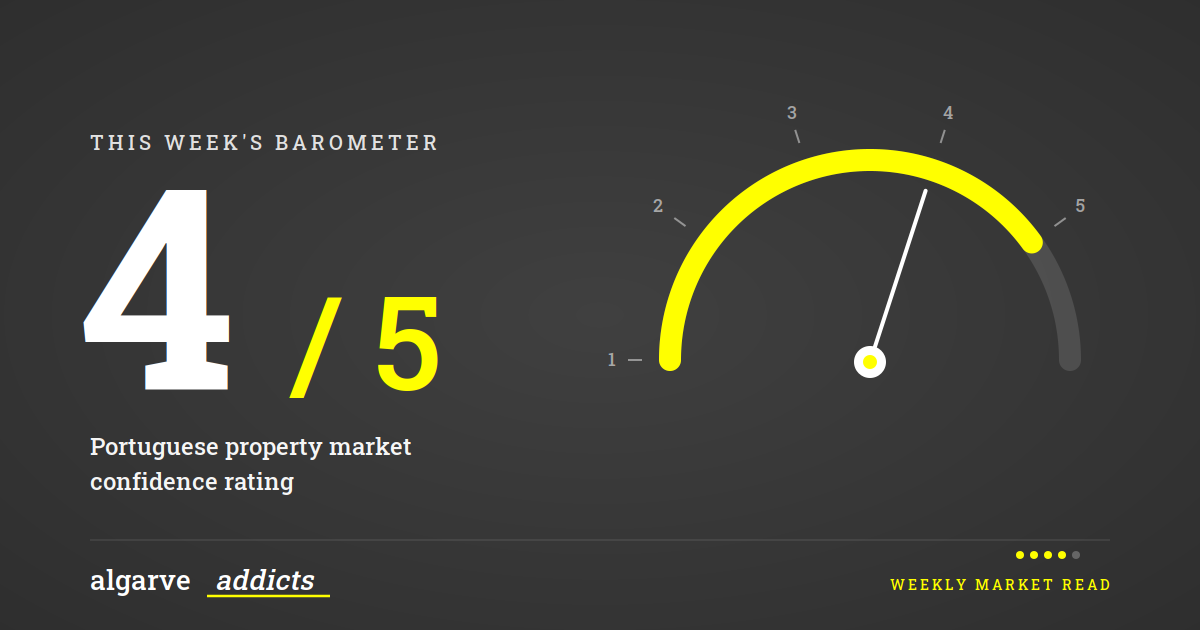
My weekly confidence rating for the Portuguese property market sits at 4 out of 5. Prices are high but supported by genuine demand. The regulatory environment is evolving but not hostile. Interest rates are manageable. The main drag is transaction volume — buyers are cautious, and that caution is reasonable. But for people who know what they want and are ready to move, the market is rewarding decisiveness.
Featured Property: Beachfront at Bayline, Armação de Pêra
This week's pick is a stunning T3 (three-bedroom) apartment at Bayline Beachfront Living in Armação de Pêra — one of the Algarve's most underrated stretches of coastline. Built in 2023, 217m², sea views, two terraces, and every finish you'd hope for at this price point. €1,190,000.
I've written a full feature on this one — read the property story here.
Thinking about making the move? Whether you're just starting to explore or you've got a shortlist and need someone on the ground, we are here to help. No hard sell, no jargon — just straight answers from a team that live and breathes this market.
Get in touch — nick.smith@algarveaddicts.com
Sources: INE (Instituto Nacional de Estatística), Idealista, Confidencial Imobiliário, European Central Bank, Diário da República, EU Regulation 2024/1028 on short-term rental data collection.
