
So you've decided to make the leap and move to Portugal. Brilliant choice! But before you start packing your sunglasses and practicing your Portuguese, there's one crucial step that'll make or break your move: sorting out your Portugal visa.
Here's the thing. Getting the right visa isn't just about ticking boxes and filling forms. It's about setting yourself up for the life you actually want to live in Portugal. Choose wrong, and you could find yourself jumping through unnecessary hoops or missing out on benefits you didn't know existed.
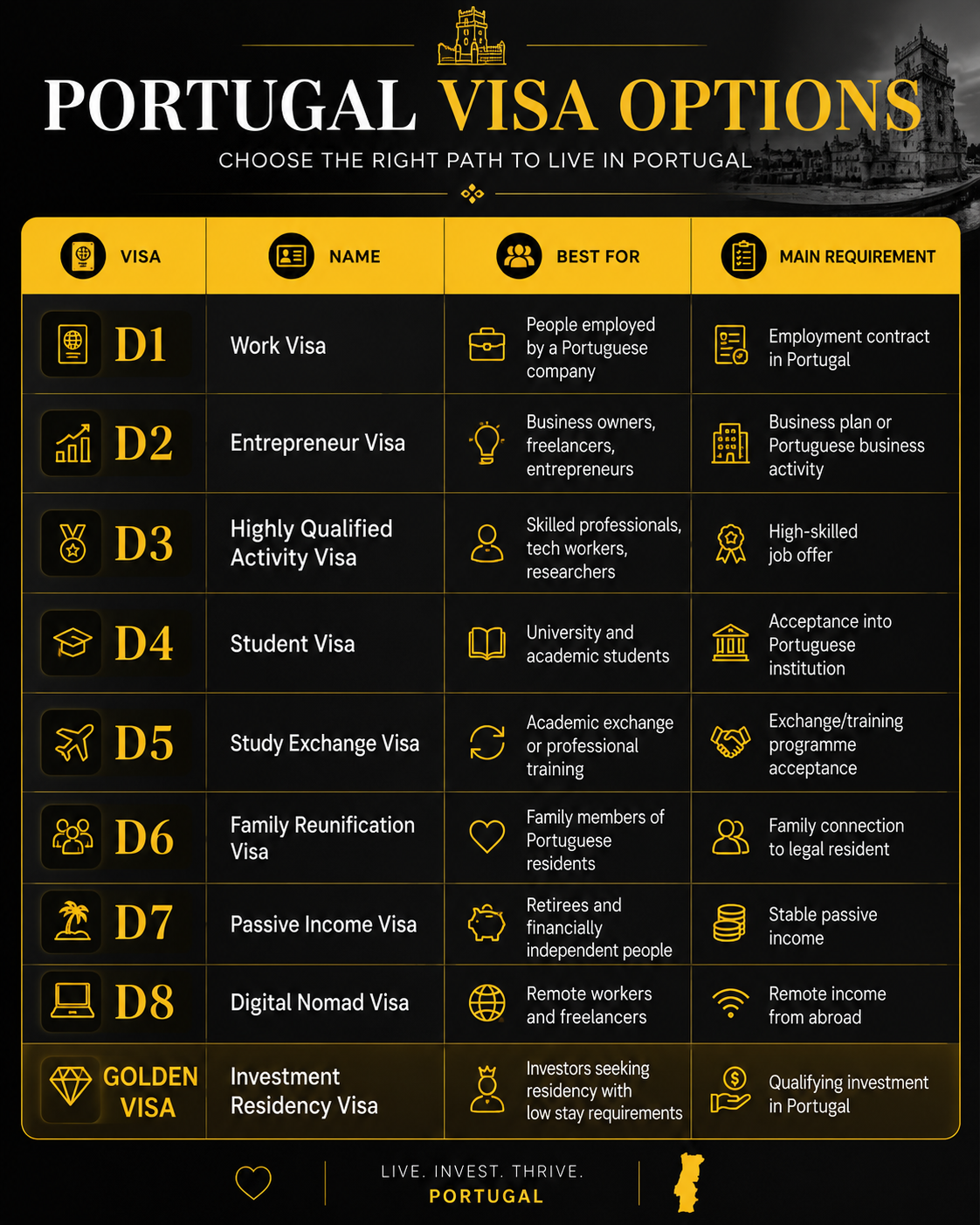
Portugal Visa Options
Understanding the Portugal Visa Landscape
First, let's clear up the basics. If you're from the EU, EEA, or Switzerland, you can skip this entire article and head straight to the beach. Lucky you! For everyone else, especially Americans, Brits, Canadians, and other non-EU nationals, you'll need a Portugal visa to stay beyond the 90-day tourist limit.
According to the Portuguese Ministry of Foreign Affairs, there are two main categories:
Temporary stay visas: For stays under one year
Residency visas: Valid for 4 months, during which you apply for a residence permit with AIMA (the agency that replaced SEF in 2023)
But here's where it gets interesting. Within these categories, Portugal offers multiple visa pathways, each designed for different lifestyles and financial situations.
The Main Portugal Visa Options for 2026
D7 Visa: The Retiree and Passive Income Favorite
The D7 has become the superstar of Portugal visas, and for good reason. It's designed for people with passive income - think retirees, landlords, investors, or anyone with regular income that doesn't require working in Portugal.
Key Requirements:
Minimum income of €870 per month (as of 2025)
Add 50% (€435) for a spouse
Add 30% (€261) per child
Income can come from pensions, rentals, investments, royalties
Official sources confirm you'll also need to show €10,440 in Portuguese bank accounts (one year's worth of minimum wage) and secure accommodation for at least 12 months.
Why it's popular: Minimal physical presence required, path to permanent residency and citizenship after 5 years, includes family members, and allows you to eventually work if you choose.
Explore if the D7 suits your retirement plans
D8 Digital Nomad Visa: For the Location-Independent
Launched in 2022, the D8 visa targets the growing army of remote workers. If you work online for non-Portuguese companies or clients, this Portugal visa is your ticket to beachside Zoom calls.
Key Requirements:
Minimum monthly income of €3,480 (4x Portuguese minimum wage)
Employment contract or freelance proof
Work must be for non-Portuguese entities
Health insurance coverage
The beauty of the D8? It acknowledges that work has changed. You can live in Portugal while keeping your international career intact.
Golden Visa: The Investment Route (Yes, It Still Exists!)
Despite rumors of its demise, the Golden Visa continues in 2025, just without the property investment option. Current options include:
€500,000 in qualifying investment funds
€500,000 in scientific research
€250,000 in arts and culture preservation
Creating 10 jobs (or 8 in low-density areas)
The big advantage: Only need to spend 7 days per year in Portugal while maintaining residency rights.
D2 Entrepreneur Visa: For Business Builders
Planning to open that dream café in Lagos or launch a tech startup in Lisbon? The D2 visa is for entrepreneurs and self-employed individuals.
Key Requirements:
Solid business plan
Sufficient funds to support yourself
Business registration in Portugal
No minimum investment amount specified
Startup Visa: For the Tech-Savvy
Different from the D2, this visa is specifically for innovative business ideas. You'll need acceptance into a Portuguese incubator and at least €10,440 in available funds.
Student Visa: For the Knowledge Seekers
Accepted into a Portuguese university? The student visa allows you to study and work part-time (up to 20 hours weekly). After graduation, you can convert to a work visa or entrepreneur visa to stay.
The Application Process: What Really Happens
Here's what the guidebooks don't tell you: the Portugal visa process is a marathon, not a sprint. Here's the real timeline:
Step 1: Document Gathering (1-3 months)
Start with the basics:
Valid passport with 6+ months validity
Criminal background checks (FBI for Americans, ACRO for Brits)
Proof of income or investment
Health insurance
Accommodation proof
Pro tip: Criminal background checks can take 12-14 weeks from the FBI. Start immediately.
Step 2: Consulate Application (1-2 months)
Book your appointment at the Portuguese consulate. Americans have options in Washington DC, Boston, Newark, New York, San Francisco, and Miami. Be prepared for:
Biometric data collection
Document submission (originals and copies)
Visa fees (around €90 for national visas)
The interview (usually informal)
Step 3: Arrival in Portugal (Within 4 months)
Your visa gives you 4 months to enter Portugal and apply for your residence permit. Don't waste time - AIMA appointments can be scarce.
Step 4: Residence Permit (2-6 months)
Welcome to Portuguese bureaucracy! You'll need:
AIMA appointment (booked online)
All your documents (again)
Proof of Portuguese address
Tax number (NIF)
Social security registration
VFS Global provides detailed checklists for each visa type, but be prepared for surprises. That "one missing document" always appears.
Portugal Visa Costs: The Full Picture
Let's talk money. The visa fee itself is relatively modest (€75-90), but the real costs include:
Document preparation and translation: €200-500
Criminal background checks: €50-100
Health insurance: €50-150/month
Legal assistance (recommended): €1,000-3,000
Travel for consulate appointments: Variable
Proof of accommodation: Deposit + first month's rent
Budget €3,000-5,000 for the complete process, not including your actual move.
Common Portugal Visa Mistakes to Avoid
After helping hundreds relocate, we've seen every mistake in the book:
Mistake 1: Choosing Based on Initial Cost Alone
The cheapest visa isn't always the best. Consider long-term implications, work rights, and family inclusion.
Mistake 2: Underestimating Income Requirements
"Minimum" means minimum. Consulates prefer seeing 20-30% above requirements for approval confidence.
Mistake 3: Missing the Accommodation Requirement
That Airbnb booking won't cut it. You need a 12-month lease or property deed. Many applications fail here.
Mistake 4: Forgetting About Taxes
Portugal visa doesn't mean Portuguese tax residency automatically, but spending 183+ days does. Understand the implications, especially for Americans who face double taxation.
Mistake 5: Going It Alone
Portuguese bureaucracy is legendary. Professional help isn't luxury; it's sanity insurance.
After Your Portugal Visa: What's Next?
Getting your visa is just the beginning. Once in Portugal, you'll need to:
Get your NIF (tax number) - Required for everything
Open a bank account - Some banks are "expat-friendly," others... not so much
Register with social security - Even if not working
Find permanent housing - That initial rental might not be your forever home
Start integration - Language classes, local connections, understanding the culture
Plan your reconnaissance mission to Portugal
Special Considerations by Nationality
Americans
Double taxation treaty exists but requires careful planning
FATCA compliance means some banks might refuse you
State pension and social security qualify for D7
Healthcare will feel miraculously affordable
Brits Post-Brexit
No longer EU citizens, so visa required
UK pensions qualify for D7
NHS coverage ends; private insurance required initially
Driving license exchange still possible
Canadians
Similar process to Americans
Strong expat communities in Algarve and Lisbon
Pensions and investment income qualify for D7
Choosing Your Portugal Visa: The Decision Framework
Ask yourself these questions:
What's your income source?
Passive income/pension → D7
Remote employment → D8
Investment capital → Golden Visa
Business plans → D2 or Startup
How often will you be in Portugal?
Full-time → Any visa works
Part-time → Golden Visa ideal
Seasonal → Consider temporary visas
What about family?
All visas allow family reunification
Children's education needs might influence location
Elderly parents can join under certain conditions
Future plans?
Want citizenship eventually → Any visa works (5-year path)
Just want EU access → Focus on Schengen benefits
Planning to work locally → Avoid restrictions of D7 initially
The Reality Check
Here's what nobody tells you about the Portugal visa process: it's simultaneously easier and harder than you expect. Easier because Portugal genuinely wants productive residents who contribute to society. Harder because the bureaucracy moves at its own pace, and that pace is decidedly unhurried.
But here's the thing. Every expat who's made it through will tell you the same thing: it's worth it. That first sunset from your Portuguese terrace, that first perfectly pulled bica at your local café, that first time a neighbor greets you by name... these moments make every form, every queue, every bureaucratic headache fade away.
Your Portugal Visa Action Plan
Ready to make it happen? Here's your roadmap:
Determine your visa type based on your situation
Start document gathering immediately (especially criminal records)
Visit Portugal if you haven't already - ensure it's right for you
Secure accommodation - This is often the trickiest part
Book consulate appointment - Slots fill months in advance
Consider professional help - Especially for complex situations
The Bottom Line
Your Portugal visa is more than a document - it's your key to a new life. Whether you're drawn by the 300+ days of sunshine, the affordable healthcare, the safety, or simply the chance to slow down and enjoy life, choosing the right visa sets the foundation for your Portuguese adventure.
The process might seem daunting, but thousands make this journey successfully each year. With proper planning, realistic expectations, and maybe a little help from those who've done it before, you'll soon be sipping wine at sunset, wondering why you didn't make the move sooner.
Portugal is waiting. The only question is: which visa will get you there?
Let's discuss your Portugal visa options
Because life's too short for bad weather and complicated healthcare.
Keywords integrated: Portugal visa, Portuguese visa, visa Portugal, Portugal visa options, Portugal visa requirements, Portugal visa types, visa for Portugal, Portuguese visa application
