
Vale do Lobo: The Honest Guide to Portugal's First Luxury Resort
Let's be clear about something upfront: Vale do Lobo is not a traditional Portuguese village. It's a manufactured resort. It was designed, built, and marketed as a luxury destination from day one. But it's been here for over 60 years, it has around 1,500 permanent residents, and it operates with many of the features of a self-contained community. So it absolutely belongs in our Algarve Unlocked series, even if it's a very different proposition from Paderne or Alcoutim.
We visited Vale do Lobo as the ninth episode in the series. We brought Duarte from our team (who grew up in Faro and knows the resort from both sides, as a local teenager and later as a property management professional) and we were shown around by Elena, who runs a yoga and wellness community in nearby Vilamoura.
📺 This article is a companion piece to our Algarve Unlocked video on Vale do Lobo. Watch the full episode for the tour of the Praca, the Well beach club, the golf and tennis centres, interviews with residents, and Duarte's local perspective.
The History: How Vale do Lobo Started
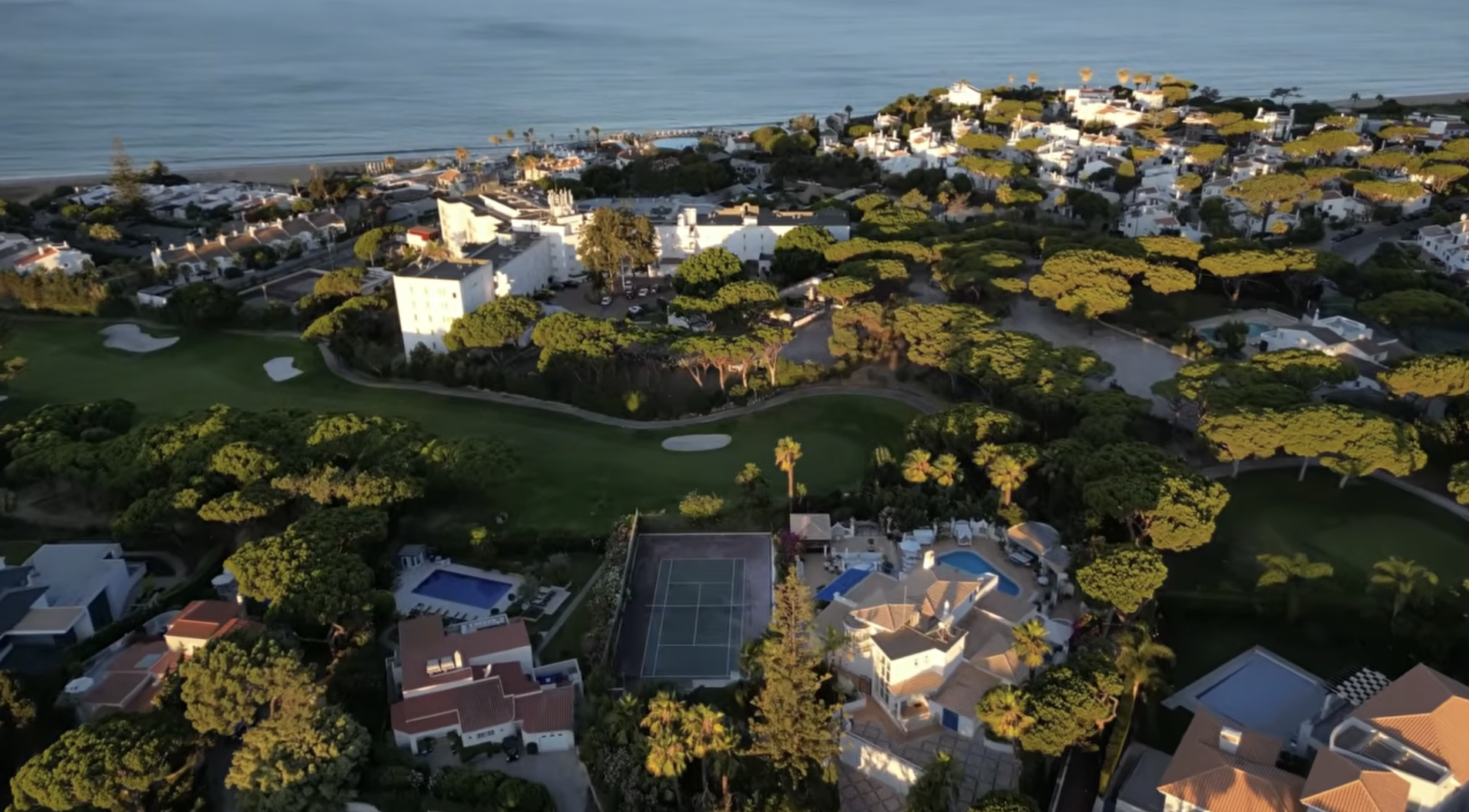
The story begins in 1962, when the Portuguese Estado Novo government decided to build Faro Airport, recognising the tourism potential of the Algarve. That same year, two British companies, Trusthouse Forte plc and Costain plc (the latter led by Sir Richard Costain), acquired an untouched stretch of coastline covered in stone pine forest and sand dunes, with the intention of building Portugal's first integrated luxury resort.
The name means "Valley of the Wolf."
Construction of the first golf course began in 1965, overseen by the legendary golfer Sir Henry Cotton. Faro International Airport opened the same year. In 1968, Trusthouse Forte and the Costain Group opened the Dona Filipa Hotel, the first five-star hotel in the Algarve, named after Philippa of Lancaster, whose marriage to King Joao I of Portugal confirmed the centuries-old Anglo-Portuguese Alliance. Two 9-hole golf courses also opened that year. The first residential complex (aldeamento) was completed in 1971, and a third 9-hole course opened in 1972.
In the mid-1970s, Dutch entrepreneur Sander van Gelder discovered Vale do Lobo during a holiday, recognised its potential, bought the resort, and moved to Portugal in 1977. Under his leadership, the resort expanded significantly, including the Roger Taylor Tennis Centre in 1980 and the Royal Golf Course in 1997.
In 2006, Vale do Lobo was acquired by a group of investors including Caixa Geral de Depositos (Portugal's largest bank). Since 2019, it has been part of ECS Capital, Portugal's largest investment fund.
Today, Vale do Lobo spans approximately 450 hectares with around 1,500 residential and holiday properties. It has roughly 1,500 permanent residents, which according to the resort represents about 10% of peak seasonal occupancy. It's the largest luxury resort in Portugal operated by a single company.
What's Actually Inside Vale do Lobo?
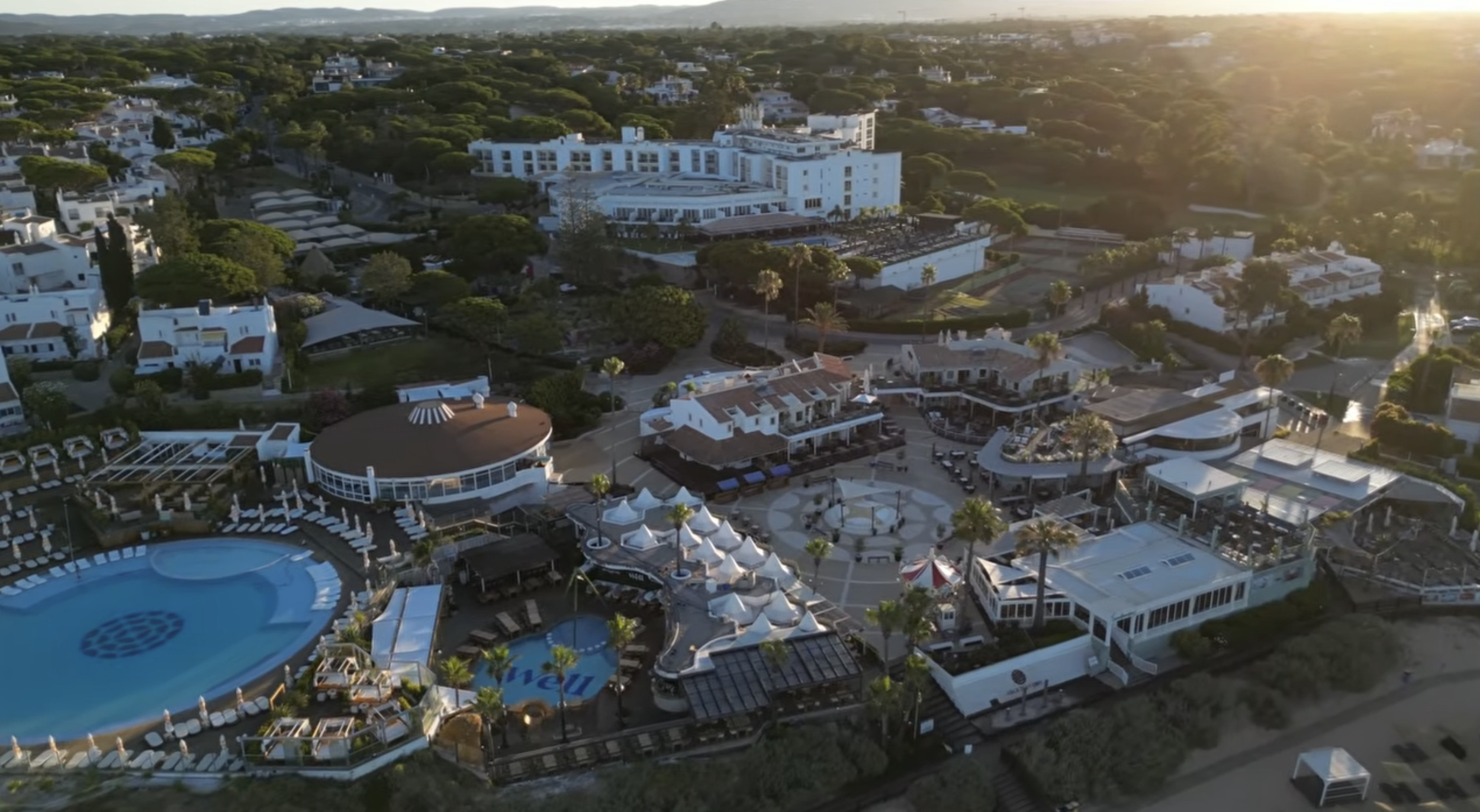
The resort is essentially a self-contained community. Here are the main areas.
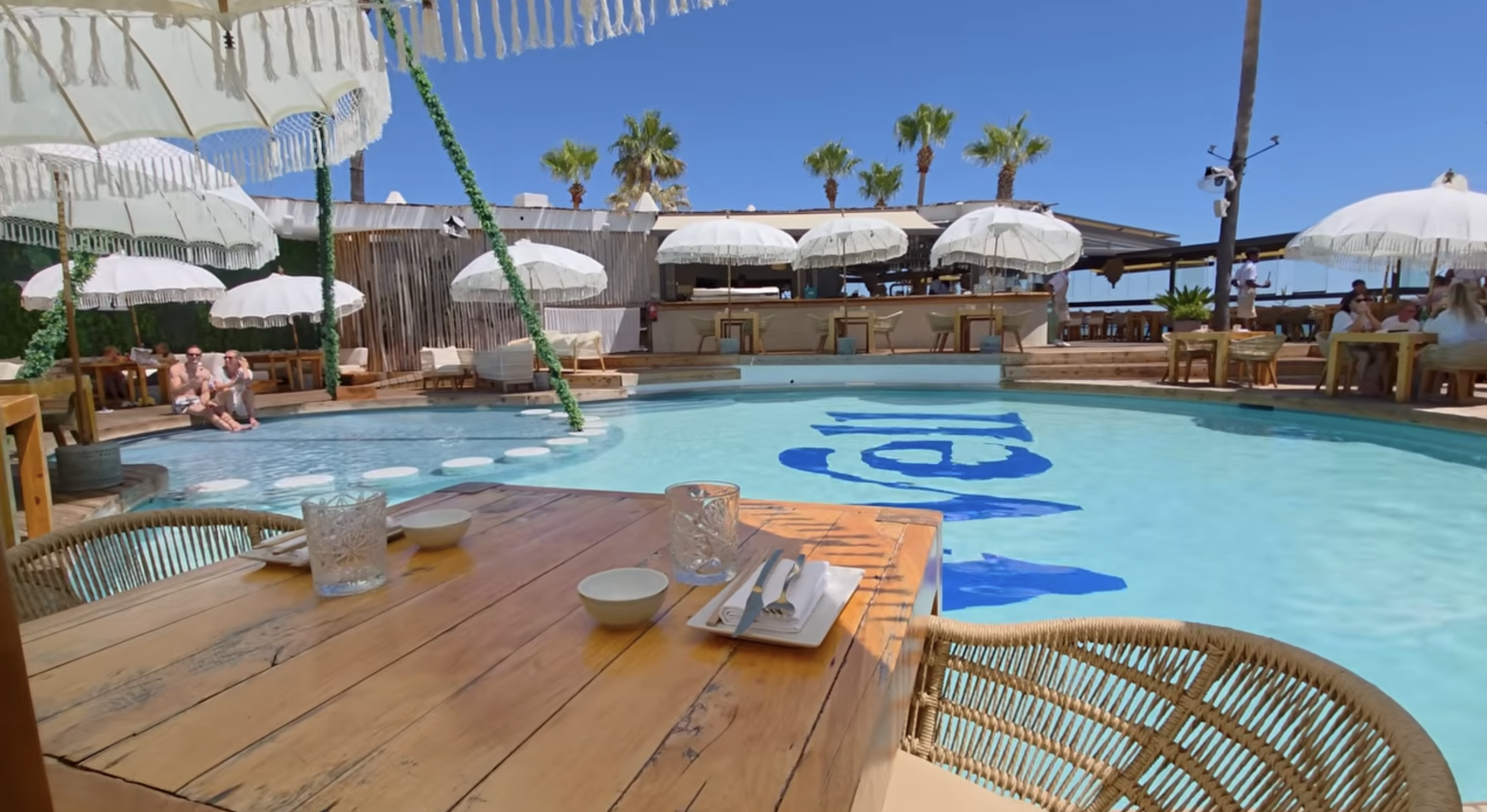
The Praça (Village Square) is the social hub. A town square ringed with two levels of bars, restaurants, and entertainment. For the 2025 summer season, Nick counted the following: Well (a restaurant and beach club that doubles as one of Vale do Lobo's flagship venues, complete with pools, jacuzzis, and Balinese beds), the Beach Bar, The Roof (a more exclusive space), Sandbanks restaurant, La Creperie, and several bars and restaurants around the square. There are four beach concessions with water sports. Live music and events run through the summer season.
The Golf Club has two 18-hole championship courses: the Royal Course (par 72, 6,059 metres) and the Ocean Course (par 73, 6,137 metres). The Royal Course's 16th hole, a par 3 played off dramatic red cliffs over the ocean, is one of the most photographed holes in European golf. The golf club area also houses the resort reception, a real estate office, the Proprietors' Club (property management services for owners), a Royal Spa, fitness centre and gym, pilates studio, art gallery, auditorium, Spikes Restaurant and Spikes Lounge Bar, a pharmacy, a law firm, car hire, hairdressers, and a cash point.
The Tennis Academy is one of the largest tennis facilities in Portugal. According to the Vale do Lobo website, it has 9 hard courts (4 floodlit), 4 artificial clay courts (all floodlit), and 6 padel courts (all floodlit), plus a swimming pool, gym, pro shop, and a bar and restaurant called Smash.
The Beach Restaurants along the coast between Vale do Lobo and the neighbouring Dunas Douradas area (which is technically separate from Vale do Lobo) include Eduardo's Beach Restaurant, Antonio Ta Certo, Izzy's Beach Restaurant, Julia's Beach Restaurant, and Maria's Restaurant. These are well-established spots, some of them among the original restaurants in the Golden Triangle.
The Shopping Centre at the resort entrance includes a grocery store, which Nick flagged as important because sometimes you just want to eat at home.
Duarte's Local Perspective
Duarte grew up in Faro and has known Vale do Lobo since he was a teenager. He later worked here professionally in the Proprietors' Club, managing the property portfolios and membership services for owners.
A few things stood out from his perspective. First, the nationality mix is broader than people assume. While many think of Vale do Lobo as British and Irish, Duarte noted that there are significant Portuguese, Brazilian, Dutch, and German communities. The Germans, he said, were actually among the first nationality to come in large numbers in the 1960s and 1970s. Some of those original families are now on their third generation, with grandchildren inheriting properties.
Second, the key difference between Vale do Lobo and neighbouring Quinta do Lago. As Duarte explained it: Quinta do Lago owns around 80% of the restaurants within its resort and aims to control the entire experience, targeting the very top 1% of the market. Vale do Lobo takes a different approach: it owns the spaces but rents them out to independent operators. The result is a more open, varied feel. Both are expensive, but the strategies are fundamentally different.
Third, the parking and access issue. Duarte was honest: most local Portuguese people won't come to Vale do Lobo beach because parking is hard to find and paid for, and you have to walk a distance to reach the sand. Portuguese beachgoers tend to prefer driving right up to the beach.
Could You Actually Live Here?
This is a different question from the one we ask about traditional villages. Nobody is moving to Vale do Lobo for authentic Portuguese culture. You'd come here for the lifestyle: the golf, the tennis, the beach, the restaurants, the security, the maintenance, and the community of like-minded people who value those things.
Several residents we spoke to on camera gave their honest takes. One loved the facilities, the improvements in recent years, and called it "a no-brainer." Another was still weighing whether it might feel too "holidayish" and worried about the winter being quiet. A third acknowledged that it doesn't represent traditional Portugal but said the facilities are gorgeous.
The year-round community aspect is real but limited. With around 1,500 permanent residents out of 1,500 properties, the resort does maintain life through the winter. But the seasonal swing is dramatic. In peak summer, the population can reach roughly 15,000. In winter, it drops back to its core residents. If you need year-round energy and social options, that's something to factor in.
Property prices reflect what you'd expect. According to local estate agents, one-bedroom apartments start from around €300,000, two to three-bedroom apartments from €500,000, linked villas and townhouses from €650,000, and detached villas from €1,500,000 upwards.
The practical side is well covered. There's a pharmacy on site, the grocery store at the entrance, and the resort is within the municipality of Loule, so you have access to the full range of municipal services. Faro airport is about 20 minutes away. Almancil, with its supermarkets and day-to-day services, is a short drive. You're not isolated in any meaningful sense.
What Vale do Lobo doesn't offer is the kind of cultural depth you'd find in a Porches or an Alcoutim. There's no centuries-old church at the centre of town, no philharmonic society, no monthly farmers market run by local growers. What there is, instead, is a very well-maintained, well-serviced, and genuinely beautiful resort that has been doing what it does for over 60 years and shows no signs of stopping.
As Nick put it: this is the resort that became a village and the village that launched the Algarve dream. Whether that dream is yours depends entirely on what you're looking for.
Vale do Lobo at a Glance
Location: Golden Triangle, central Algarve coast, municipality of Loulé
Founded: 1962 by Trusthouse Forte plc and Costain plc
Size: approximately 450 hectares
Properties: approximately 1,500
Permanent residents: approximately 1,500
Peak seasonal population: approximately 15,000
Faro airport: approximately 20 minutes by car
Golf: Two 18-hole championship courses (Royal and Ocean)
Tennis: 13 tennis courts + 6 padel courts (floodlit), swimming pool, gym
Beach: 2km of ocean frontage with multiple beach concessions
Restaurants: 15+ across the resort and surrounding beach area
Shopping: Grocery store at entrance; Almancil nearby for full services
Pharmacy: On site at the golf club area
Key venues: The Praça (village square), Well beach club, Spikes Restaurant, Smash (tennis restaurant)
Frequently Asked Questions
Is Vale do Lobo a town or a resort? Technically it's a resort, founded in 1962 as a purpose-built luxury development. But with 1,500 permanent residents, its own restaurants, pharmacy, grocery store, sports facilities, and community events, it functions in many ways like a self-contained village. It's part of the municipality of Loule.
How does it compare to Quinta do Lago? Both are part of the Golden Triangle and both are expensive. The key difference, as our team member Duarte explained, is that Quinta do Lago owns most of its restaurants and targets the very top of the market with a closed, controlled experience. Vale do Lobo rents its spaces to independent operators, creating a more open and varied atmosphere. Vale do Lobo also has a longer history (founded 1962 vs Quinta do Lago in 1972).
Can anyone use the facilities? Yes. The restaurants, beach concessions, and many facilities are open to visitors, not just property owners. The golf courses and tennis academy are also open to non-residents, though booking in advance is recommended in summer.
Is it quiet in winter? Yes, significantly. The permanent population of around 1,500 represents about 10% of peak season numbers. Some restaurants and beach venues close or reduce hours in winter. That said, the core community and key facilities operate year-round.
What are property prices like? Apartments start from around €300,000 for a one-bedroom. Detached villas start from approximately €1,500,000. Prices vary significantly based on location within the resort, proximity to the beach or golf courses, and property condition.
Thinking about relocating to the Algarve? We've been helping people make the move since our earliest days as a YouTube channel, and today we're a fully licensed real estate agency and certified tour operator. Whether you need help finding a home, understanding the visa process, or just want someone to show you around, get in touch through our website and let's chat about making the Algarve work for you. You can also explore our full range of relocation services here.
